


Designing a Custom Ring with Coloured Lab Grown Diamonds
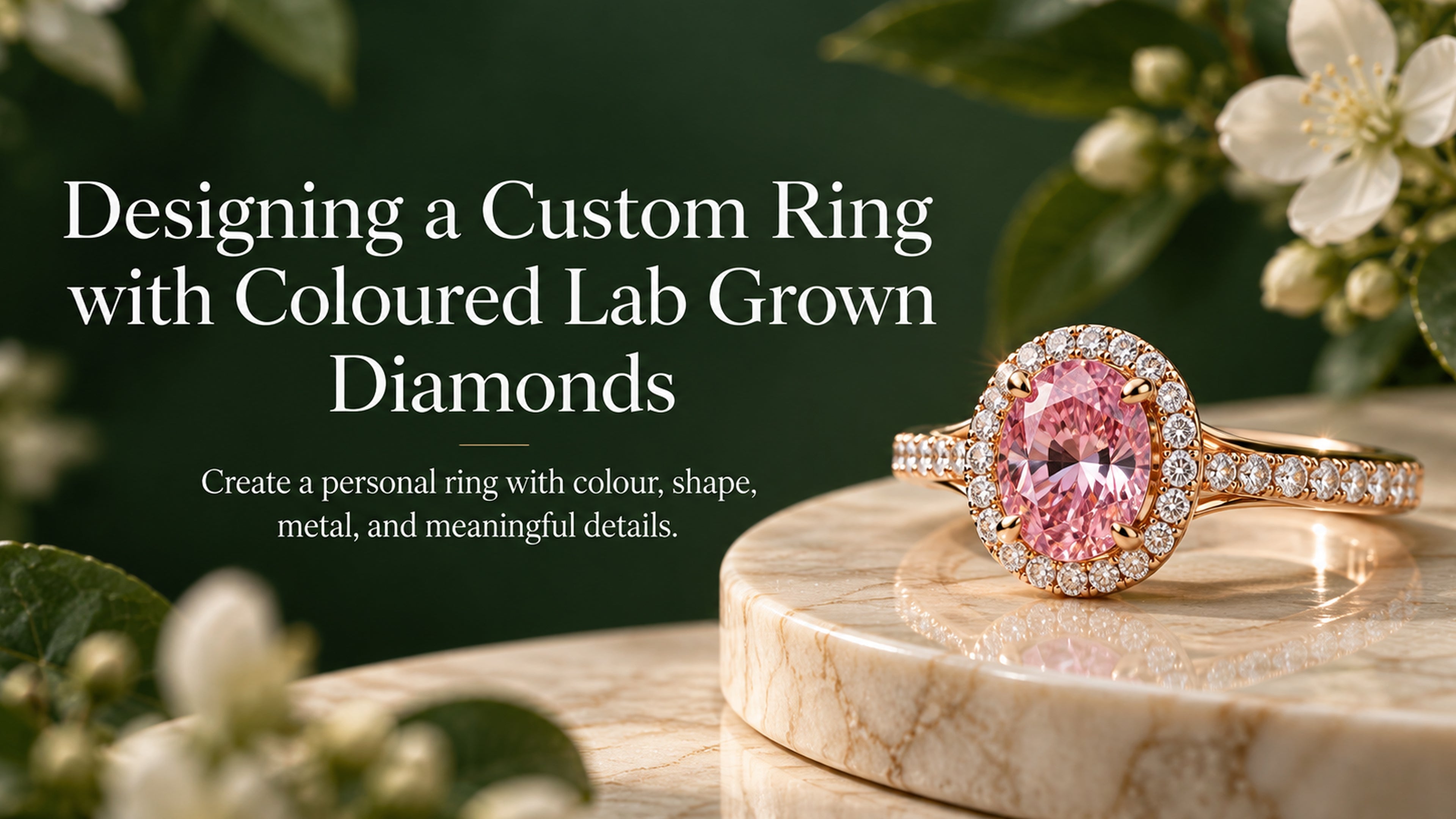
A custom ring starts with an idea: a colour you love, a shape that catches your eye, or a meaningful detail you want to wear every day.
Coloured lab grown diamonds offer a distinctive starting point for that design. From soft pink to bright yellow or rich blue, colour can give your ring a personal character and guide your choice of metal, setting, and accent stones.
Whether you are creating an engagement ring, an anniversary gift, or a piece for yourself, this guide explains how to design a custom coloured lab grown diamond ring.
What Are Coloured Lab Grown Diamonds?
Lab grown diamonds are diamonds created in controlled laboratory environments. They have the same carbon crystal structure and nearly the same chemical, physical, and optical properties as natural diamonds.
Colour can arise during growth or through post-growth treatment. Ask your jeweller about the specific diamond’s origin, colour, and any disclosed treatments before choosing it.
1. Start with the Purpose of Your Ring
Before selecting a diamond, decide how you want to wear the finished piece.
An engagement ring intended for everyday wear may call for a different design from a statement ring worn occasionally. Think about your routines, preferred jewellery, and how prominent you want the ring to feel.
Useful questions include:
-
Is this an engagement ring, a gift, or a personal purchase?
-
Do you prefer a subtle colour or a bold centre stone?
-
Will you wear it daily?
-
Should it sit beside another ring?
-
Are there existing pieces you want it to complement?
These answers give your jeweller a clear direction.
2. Set a Budget for the Complete Design
Your budget should cover more than the centre diamond. The metal, setting, accent stones, and custom work all contribute to the final price.
Ask for a quotation that clearly identifies:
-
The selected centre diamond.
-
Metal type and purity.
-
Any side stones or pavé diamonds.
-
Design and manufacturing charges.
-
Engraving, delivery, and applicable taxes.
-
Any included resizing or aftercare.
If the first design exceeds your budget, discuss which details can be adjusted while preserving the look you want.
3. Choose Your Diamond Colour

Colour will often be the defining feature of your custom ring. Start with the shade you enjoy looking at rather than choosing solely from a colour name.
Pink Diamonds
A pink centre stone can suit a delicate design or become the focus of a bold ring. Compare softer and stronger shades to decide how noticeable you want the colour to be.
Yellow Diamonds
Yellow offers a bright focal point. You might choose a simple solitaire that highlights the centre stone or add colourless side diamonds for contrast.
Blue Diamonds
A blue diamond can bring a distinctive colour accent to a clean, modern setting or a more detailed design.
Other Colours
Depending on your jeweller’s inventory, you may also explore additional hues. Ask to see the available stones rather than assuming every colour can be supplied in your preferred size and shape.
Design tip: Use photographs as a starting point, then request videos or direct viewing of the actual diamond. Lighting and screens can influence your impression of its colour.
4. Look Beyond the Colour Name

Two diamonds described as “pink” or “yellow” may have noticeably different appearances.
When comparing stones, ask your jeweller to explain:
-
The main colour and any modifying hues.
-
How light or deep the colour appears.
-
How evenly the colour is distributed.
-
Whether the appearance changes noticeably under different lighting.
-
How the colour is described on the grading report.
Do not assume a seller’s descriptive name is the same as a laboratory colour grade. Confirm the wording on the report for your chosen stone.
Design tip: Compare your shortlisted diamonds under similar lighting so you can judge their differences more clearly.
5. Select a Shape That Suits Your Design

Shape changes the outline and overall character of the ring.
|
Diamond Shape |
Design Direction |
|
Round |
A balanced circular centrepiece |
|
Oval |
A softly elongated silhouette |
|
Cushion |
A square or rectangular outline with rounded corners |
|
Emerald |
A structured outline with step-cut facets |
|
Radiant |
A square or rectangular silhouette with clipped corners |
|
Pear |
An asymmetric outline with a rounded end and point |
|
Marquise |
A long silhouette with pointed ends |
|
Heart |
A recognisable, expressive centrepiece |
The same colour can look different from one diamond to another, so select the actual stone as well as the shape.
Check its dimensions in millimetres alongside its carat weight. Carat measures weight, and diamonds of equal weight can have different measurements.
6. Choose the Setting

Your setting should support the centre diamond and create the visual effect you want.
Solitaire
A solitaire keeps attention on the coloured diamond. It is a useful option when you want a simple ring with a distinctive centrepiece.
Halo
A halo surrounds the centre stone with smaller diamonds. Colourless accents can create a clear contrast with a coloured centre diamond.
Hidden Halo
A hidden halo adds detail beneath or around the lower part of the centre setting. Ask for side views so you can see how much of this detail will be visible.
Three-Stone
A three-stone ring lets you combine a coloured centre diamond with complementary side stones. Compare their shapes and proportions to keep the design balanced.
Bezel
A bezel frames the diamond with a metal rim. It can suit a smooth, clean outline, although the amount of visible metal should be considered in the design.
Design tip: Ask your jeweller to show the ring from above and from the side. Setting height matters to both appearance and comfort.
7. Pair Your Diamond with a Metal

The metal colour contributes to the finished ring’s appearance. Treat these combinations as creative starting points rather than fixed rules:
|
Diamond Colour |
Metal Combinations to Explore |
|
Pink |
Rose gold for a coordinated palette; white metal for contrast |
|
Yellow |
Yellow gold for a coordinated palette; white metal for contrast |
|
Blue |
White gold or platinum for a cool palette; yellow gold for contrast |
You can also consider a two-tone design, such as one metal for the band and another for the diamond setting.
Ask to see examples or mock-ups with your chosen diamond. Discuss the alloy, finish, maintenance, and any known metal sensitivities before deciding.
8. Decide Whether to Add Accent Diamonds
Accent stones can frame the centre diamond or add detail along the band.
Possible approaches include:
-
Colourless side diamonds around a coloured centre stone.
-
A pavé band for additional sparkle.
-
Small coloured accents in an otherwise understated design.
-
A simple band that keeps the centre stone prominent.
Consider how much detail you want. Adding more elements does not automatically make the design more successful; the proportions should work together.
9. Review Quality and Documentation
Colour may be your first priority, but also review clarity, craftsmanship, measurements, and the diamond’s overall appearance.
Ask for an independent report that identifies laboratory-grown origin and describes the relevant colour characteristics. GIA offers laboratory-grown coloured diamond reports with colour information and, depending on the report type, additional quality assessments.
Check the report number through the issuing laboratory’s official verification service where available. Ask your jeweller to explain any treatment comments and the care requirements for the specific stone.
A grading report documents characteristics; it is not a monetary appraisal.
10. Add Meaningful Personal Details
Customisation can be subtle. A small detail may be enough to make the ring feel personal.
Consider:
-
An engraved date or short message.
-
A distinctive band profile.
-
A meaningful combination of centre and side stones.
-
A detail visible only from the side.
-
A design that complements an existing wedding band.
Choose details that matter to you and fit comfortably within the ring’s construction.
11. Review the Design Before Production
Before approving the ring, request drawings or a digital model showing the proposed design.
Confirm:
-
The exact centre diamond and accent-stone specifications.
-
Ring size and band width.
-
Setting height.
-
Metal type and finish.
-
Engraving.
-
Whether a wedding band can sit alongside it.
-
Final price and expected completion date.
A digital render illustrates the proposed design, but lighting and rendering can affect how colour appears. Use images of the actual diamond alongside the model.
Also confirm how design revisions work and when the order becomes final.
12. Understand Custom-Order Terms
Read the seller’s policies before paying. Custom rings may have different return or cancellation terms from ready-made pieces.
Ask about resizing, warranty coverage, repairs, and aftercare. If you need the ring for a proposal or anniversary, confirm the production schedule and allow time for delivery and fitting adjustments.
Keep a copy of the approved specifications so you can review the finished ring against them.
Frequently Asked Questions
Are coloured lab grown diamonds real diamonds?
Yes. They are diamonds grown in laboratory environments. Their colour may arise during growth or through post-growth treatment.
Can I customise the colour, shape, and setting?
Your options depend on the jeweller’s inventory and manufacturing capabilities. Start by confirming which actual diamonds are available, then build the design around your chosen stone.
Which metal looks best with a coloured diamond?
There is no single best combination. Compare coordinated palettes and contrasting metals to find the appearance you prefer.
Can I use a coloured lab grown diamond in an engagement ring?
Yes. Discuss the specific stone, setting, comfort, and care requirements with your jeweller to create a ring suited to its intended use.
How long does a custom ring take to make?
Timing depends on sourcing, design revisions, and production. Request a confirmed estimate before ordering, especially if you have a fixed occasion date.
Can a custom ring be resized or returned?
Policies and technical limits vary. Confirm the terms for your exact design before approving production.
Create a Ring That Reflects Your Style
Designing a custom ring with coloured lab grown diamonds brings together colour, shape, craftsmanship, and personal meaning.
Choose the actual diamond carefully, explore the design from every angle, and confirm the final specifications before production. Each decision helps create a ring you will enjoy wearing.
Explore our coloured lab grown diamond jewellery collection and contact us to discuss your custom ring ideas.


